Highsfield Sparkling Drink Videos: A Practical Method For Testing A Video Draft
Before writing a video prompt, decide what a viewer should notice first. That decision matters for beverage marketing teams researching Highsfield and Seedance 2.5. The example here uses sparkling drink videos to give a refreshment concept a clear visual focal point. Defining the focal point simplifies the rest of the brief. It also makes review more concrete: a draft can be assessed against its purpose instead of being accepted simply because the lighting, background or movement looks impressive.
A Highsfield guide can help organize a creative brief, while the generator supplies current options for a particular model. Those roles are different. When planning a Seedance 2.5 concept, verify accepted inputs and settings before submitting any generation request. Public examples are useful for visual analysis, but their presence on a workflow page does not prove they share the same model, settings or source material as the clip you want to create.
Make Review More Specific Than Personal Taste
Consider a fictional assignment for beverage marketing teams. Its purpose is to give a refreshment concept a clear visual focal point. The setting is a lemon-yellow tabletop in soft studio light, and the required visual detail is the glass rim and transparent liquid. Give the viewer one action to recognize before adding another. The published lemon-drink storyboard is helpful for studying how an action can be divided into shots. It is a planning reference, not a recipe, ingredient statement or verification of a beverage brand.

A review exercise starts by naming a failure the team is willing to reject. In this scene, that failure is that the glass bends or the citrus decoration changes size. The purpose is still to give a refreshment concept a clear visual focal point, so the review should concentrate on the details that support it. A specific failure criterion gives the next attempt a reason. The team can then preserve working elements while changing the instruction connected to the largest mismatch.
A Seedance 2.5 Scene Brief to Evaluate
A proposed scene prompt could read: "Setting: a lemon-yellow tabletop in soft studio light. Action: Small bubbles rise through a glass of sparkling water. Camera: a locked close-up with the glass fully in frame. Preserve the glass rim and transparent liquid. Keep the background stable and end with the subject still recognizable." This is an original planning example, not a tested generation record. Select only input and output options the current model actually supports.
Describe the opening and closing states in ordinary visual language. Start with the subject established in its setting; end after the intended action is visible, with the glass rim and transparent liquid still recognizable. The closing state should complete the action rather than introduce another one. This does not guarantee frame control in every model. It makes the intention clear enough that the resulting clip can be compared with the original brief.
Record a small number of draft comparisons that answer specific questions. One might test a simpler action; another might test a more stable viewpoint. Keep unrelated settings unchanged when possible. A controlled revision makes the result easier to interpret. In this scene, observe what happens to the glass rim and transparent liquid. A better-looking result is useful evidence only when the reviewer can explain which production requirement it satisfies more convincingly than the previous draft.
Use Public References With Their Context Intact
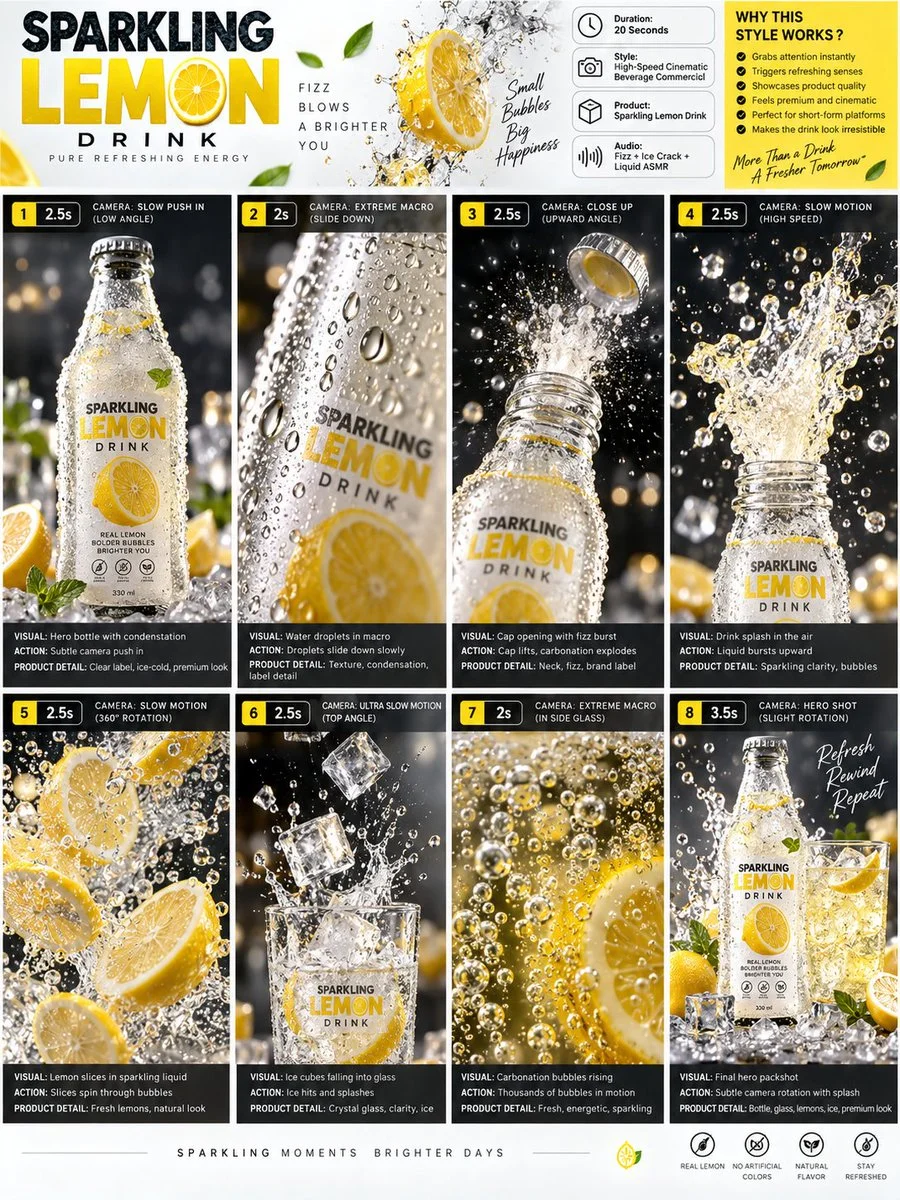 Published Highsfield visual reference: Sparkling lemon drink storyboard with separate shot panels.
The published image to video ai free shows a lemon-drink storyboard arranged in distinct panels. It is useful for studying using a sequence of small visual decisions to organize a larger idea. The reference supplies a composition, not an automatic motion instruction. Use that distinction when planning the proposed scene. This is a reference from the public site, not a newly generated result or proof of Seedance 2.5 performance.
Cinema Verite in 1970s Paris; published Seedance 2.0 example. Open the published video example.
The video poster shows a person beside a flower display. Open the clip to study the relationship between a subject, a setting and a restrained viewpoint, then judge the moving result rather than inferring it from the poster. This example is labeled Seedance 2.0 on the homepage, so it should not be presented as a Seedance 2.5 result. Inspect the full action before applying a similar framing decision. The proposed project remains a separate, hypothetical exercise.
Review the Action and Required Details
For this particular concept, inspect refraction, rim continuity and bubble direction. Reject the draft if the glass bends or the citrus decoration changes size. That is a visible requirement rather than a general preference for a polished look. If the mismatch appears in only part of the clip, identify that moment before changing the brief. An acceptable opening frame does not excuse a subject or environment that becomes inaccurate during the intended action.
Watch the connection between the subject and its environment. Shadows, reflections, object contact and background perspective can expose an unstable scene even when the main movement looks convincing. In this example, inspect refraction, rim continuity and bubble direction. The surrounding scene should support the motion rather than contradict it. If the intended use is a mood study, some stylization may be acceptable, but that choice should be deliberate rather than a way to overlook a defect.
Use the normal playback speed as well as paused frames. An isolated still can reveal a shape problem, while a full playback reveals whether the movement communicates the intended action. Neither view replaces the other. For this exercise, inspect the moment when the glass bends or the citrus decoration changes size becomes visible. That observation should determine whether the next step is a prompt revision, a simpler scene or a decision to use another kind of production material.
Complete the Highsfield Workflow Carefully
Treat the displayed credit estimate as a production input. Reserve room for revisions and judge the cost of reaching an acceptable clip rather than counting only the first attempt. For Seedance 2.5, verify the current settings in Highsfield before submission. The estimate should be checked again if a setting changes. Keep the chosen parameters with the draft so another teammate can understand the conditions under which it was created.
The edit should serve the action the brief promised. Trim away an unnecessary lead-in, leave enough time for the glass rim and transparent liquid to register and add the verified caption separately. The finished sequence should have a clear reason to end. For this project, save the chosen draft with its review notes and make the final edit from that approved version. Save the selected result with the approved copy so the person publishing it does not have to guess which version or message the reviewer accepted.
The point of this sparkling drink exercise is to give a refreshment concept a clear visual focal point with a scene that another person can understand and review. Highsfield’s Seedance 2.5 guidance provides a starting framework, while the actual generator defines current technical options. Keep the brief small enough to test and specific enough to reject. If the draft preserves the glass rim and transparent liquid and completes the intended action, it can move into editing with a clear reason for being there.